Selecting A Metal Sling for Your Application
April 14, 2026The optimization of a lifting system requires a rigorous evaluation of the operational environment and the mechanical demands of the load. While synthetic slings offer significant advantages in terms of weight and flexibility, certain industrial applications necessitate the superior metallurgical properties of metal slings. Every lift requires safety and efficiency, but when an application presents riggers with high temperatures, rugged conditions, and the need for adjustability, riggers tend to choose between wire rope, alloy chain, and wire mesh. This selection process is governed by the structural requirements of the task and the regulatory frameworks established by OSHA 1910.184 and ASME B30.9. Metal slings are preferred when the lift presents extreme thermal conditions, highly abrasive surfaces, or a requirement for high-capacity durability that exceeds the capabilities of polyester or nylon fibers.
Why Choose Metal Slings?
Synthetic fibers offer excellent strength-to-weight ratios, but they remain susceptible to thermal degradation and advanced cutting in severe environments. Sling protection and engineered sleeves can extend the lifecycle of synthetic slings, but they cannot match the inherent resistance of high-grade steel. When a lift occurs in proximity to molten materials, sharp metal shards, or extreme cold, metal slings provide the necessary advantage. Lift-All maintains industry standards by performing proof-testing on welded and mechanical chain slings as well as wire rope slings. Lift-All occasionally performs destructive testing on various designs to ensure that every metal sling meets or exceeds the industry standards for tensile strength and resilience.
Wire Rope Slings: The Versatile Workhorse
Wire rope represents a balanced solution by providing high strength alongside a degree of flexibility and abrasion resistance. On a per-capacity basis, wire rope is often the most cost effective steel lifting medium available. These slings typically feature an Independent Wire Rope Core (IWRC) to maintain structural integrity at temperatures up to 400°F. The construction of the rope significantly influences its performance. For instance, a 6×19 construction utilizes larger diameter wires to provide enhanced abrasion resistance at the cost of some flexibility, whereas a 6×37 construction or the E-Z Flex design employs a higher number of smaller wires to increase flexibility and resistance to kinking. Lift-All utilizes the Flemish Eye splice technique to form the eyes of the sling, which provides an added margin of reserved strength should the swaged sleeve become compromised.
Tagging and Inspection Requirements for Wire Rope
To remain compliant with OSHA 1910.184(f)(1), wire rope tags must include the rated capacity for various hitches and the angles upon which those capacities are based. Identifying when a wire rope sling has reached its removal criteria is vital for site safety. The Lift-All catalog provides specific details on fatigue, broken wires, and corrosion. The Lift-All team provides on-site seminars and digital tools, such as wire rope inspection videos, to educate riggers on the technical thresholds for removing wire rope slings from service.
FAQ for Wire Rope Slings
How do I know if a wire rope sling is right for my lift hitch?
A qualified person must evaluate the specific load and environment to ensure the chosen wire rope construction—whether the abrasion-resistant 6×19 or the flexible E-Z Flex™—is appropriate for the intended hitch configuration. Each lift presents unique criteria. Wire rope is an excellent choice for rugged applications that require superior abrasion resistance while maintaining enough flexibility to accommodate the hitch.
Does Lift-All provide documentation for new wire rope slings?
Every Lift-All sling is accompanied by a safety bulletin that details essential operational instructions, environmental considerations, and removal criteria. This documentation ensures that the end user has immediate access to the technical data required to maintain compliance with federal safety regulations and industry best practices.
Alloy Chain Slings: Rugged Durability for Severe Service
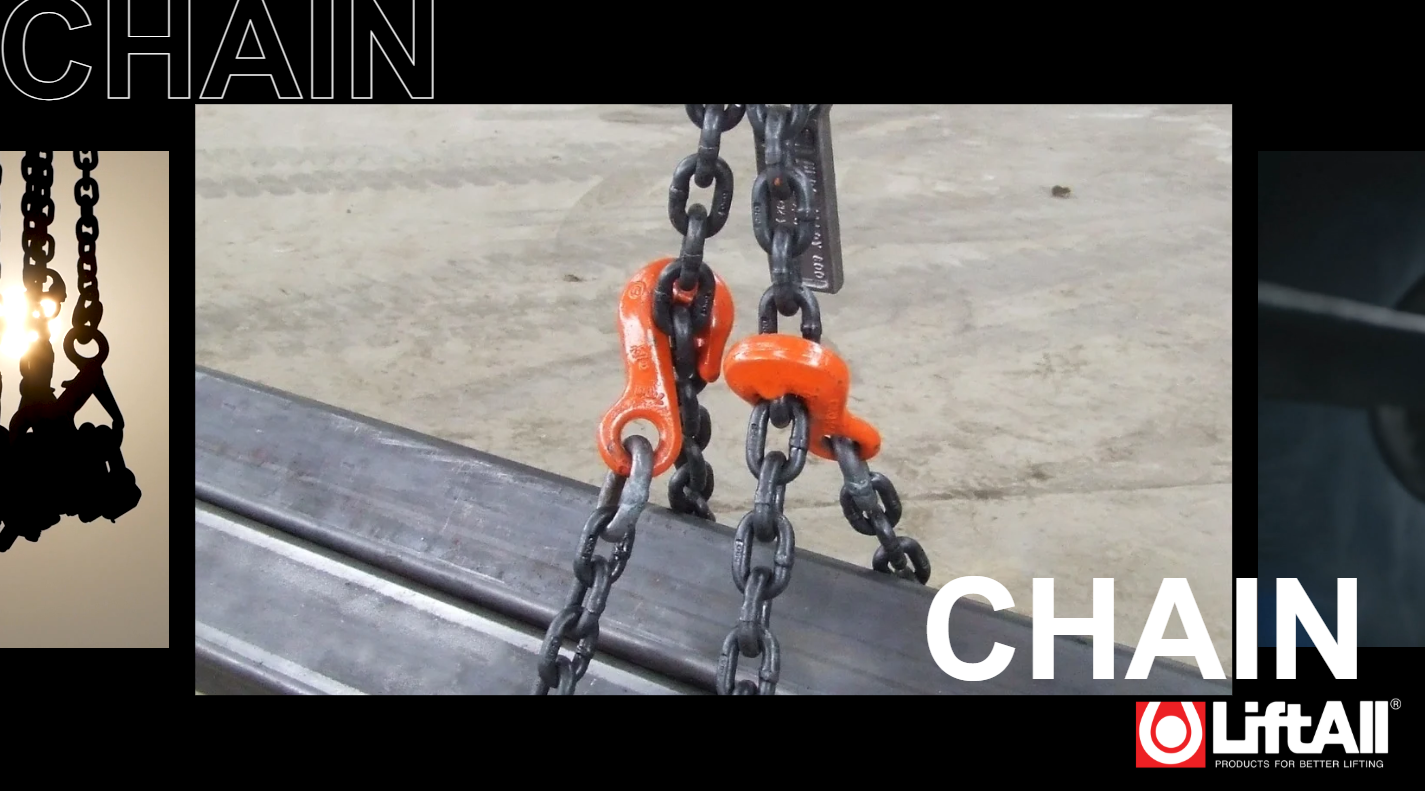
Alloy chain slings are engineered for the most demanding lifting environments, offering unparalleled resistance to heat and physical abuse. Lift-All provides grade 100 chain for sizes ranging from 7/32 inch through 3/4 inch, and grade 80 chain for larger diameters up to 1-1/4 inches. The alloy steel construction, combined with a black oxide finish, ensures a long service life even in corrosive or high-temperature settings. Unlike other sling types, chain can be repaired, proof tested, and recertified, which provides a significant long-term return on investment. Users must adhere to the Working Load Limit reduction charts found in the Lift-All catalog when operating at elevated temperatures.
Mechanical versus Welded Chains
Lift-All proof tests all new welded chain slings and mechanical chain slings, even though testing for the latter is not strictly mandated by OSHA or ASME standards. This protocol, as detailed in Tech Bulletin CH-29, provides several benefits. It offers empirical verification that the assembly is properly rated and tagged, confirms that all components are suitably matched, and ensures that repairs have been completed to original factory specifications.
Documented Annual Inspections
OSHA regulations require that all chain slings receive a thorough inspection at least once per year by a competent person. These inspections must be documented. Lift-All’s trained representatives provide these services, ensuring that your facility remains in compliance while identifying subtle signs of wear or deformation that might be missed by less experienced personnel.
FAQ for Chain Slings
Are all Lift-All chain slings proof tested?
Yes. All welded and mechanical chain slings from Lift-All are proof-tested. Even though mechanical slings are not required to be tested by OSHA, Lift-All performs this step to verify that the product is properly rated, all components are suitable, and the assembly has been correctly completed.
What information is required on a chain sling tag?
To pass inspection, each chain sling must have a permanent steel capacity tag that is serialized for identification. This tag must clearly state the Rated Capacity (Working Load Limit), the Chain Grade, and the Number of Legs in the assembly.
Can a chain sling be used in a choker hitch?
Yes, a chain sling can be used in a choker hitch orientation. When using a choker hitch, reduce the capacity to 80% of the vertical rating. Ensure the angle of choke is 120° or greater.
Examples:
A single leg of 3/4″ chain used in a choker hitch would have a rating of 0.8*(35,300 lbs.) ≈ 28,300 lbs.
A three-leg bridle of 3/4″ chain with each leg in a choker hitch would have a rating of 0.866*(28,300 lbs.)*(3 Legs) ≈ 73,500 lbs. at 60°
| Chain Sling Choker Rated Capacity* (lbs.) | |||||||||
| Grade |
Nominal Chain Size | Single Leg | Double Leg | Triple & Quad Leg | |||||
| in. | mm. | Horizontal Angle | |||||||
| 90° | 60° | 45° | 30° | 60° | 45° | 30° | |||
| 100 | 7/32 | 5.5 | 2,100 | 3,600 | 3,000 | 2,100 | 5,500 | 4,400 | 3,200 |
| 9/32 | 7 | 3,500 | 6,100 | 4,900 | 3,500 | 9,100 | 7,400 | 5,200 | |
| 3/8 | 10 | 7,100 | 12,300 | 10,000 | 7,100 | 18,400 | 15,100 | 10,600 | |
| 1/2 | 13 | 12,000 | 20,800 | 17,000 | 12,000 | 31,200 | 25,500 | 18,000 | |
| 5/8 | 16 | 18,100 | 31,300 | 25,600 | 18,100 | 47,000 | 38,400 | 27,100 | |
| 3/4 | 20 | 28,300 | 49,000 | 40,000 | 28,300 | 73,500 | 60,000 | 42,400 | |
| 80 | 7/8 | 22 | 27,400 | 47,400 | 38,700 | 27,400 | 71,100 | 58,000 | 41,000 |
| 1 | 26 | 38,200 | 66,100 | 53,900 | 38,200 | 99,100 | 81,000 | 57,200 | |
| 1-1/4 | 32 | 57,800 | 100,200 | 81,800 | 57,800 | 150,200 | 122,700 | 86,700 | |
*WARNING: Do not exceed rated capacities. Sling capacity decreases as the angle from horizontal decreases. Slings should not be used at angles of less than 30°. Refer to the chain chart on this page and the Effect of Angle chart in the General Information section of the Lift-All catalog.
Wire Mesh Slings – the Specialist for Abrasive Loads
As the only manufacturer of wire mesh slings in the United States, Lift-All provides a unique solution for handling abrasive or hot loads up to 550°F. The wide bearing surface of wire mesh helps to distribute the load weight across a larger area, which reduces the pressure on the load and helps riggers maintain better balance. The galvanized steel construction is highly resistant to both corrosion and cutting, making it the superior choice for handling metal loads with sharp edges. Every new wire mesh sling is proof tested at Lift-All. Furthermore, Lift-All can repair and recertify all brands of wire mesh slings, ensuring they meet or exceed their original performance specifications.
Inspection and Maintenance for Metal Slings
Sling safety is managed through a three-tier approach: initial inspection for new items, frequent inspection before each use, and periodic documented annual inspections. The service intervals are defined by WSTDA WS-1. If a sling meets any of the removal criteria outlined in the Lift-All catalog, it must be removed from service immediately to prevent injury.
FAQ for Metal Slings
How often does OSHA require metal slings to be inspected
Daily frequent inspections are required for all slings. Documented inspections are required for chain slings on an annual basis.
Can I use a metal sling if the tag is missing
No. The identification tag for any sling must be attached and legible to pass inspection. Using an untagged sling is a violation of safety standards and introduces unquantified risk to the lifting operation.
Compliance and Training Support
Maintaining a safe rigging environment requires a team of qualified individuals who understand the nuances of sling selection and maintenance. Lift-All offers comprehensive Safety-in-Lifting training in both English and Spanish to educate personnel on safe procedures and inspection criteria. This support helps organizations meet the OSHA definition of a qualified person through the acquisition of extensive knowledge and successful demonstration of problem-solving in lifting applications.
Lift-All factory-trained representatives also provide on-site inspection services, allowing facilities to have all their rigging hardware evaluated in a single, documented survey.
FAQ for Training & Compliance
Is sling safety training required for compliance?
OSHA states that a competent person must inspect slings. Lift-All provides on-site training to ensure your team is educated on safe practices and capable of performing these inspections to maintain a compliant workplace.
Who can help me with my annual sling inspections?
The highly trained Lift-All team offers professional on-site annual sling inspections and safety training to help educate the industry on the latest rigging standards and best practices.
Sources Consulted Included
- https://www.osha.gov/laws-regs/regulations/standardnumber/1910/1910.184
- https://www.asme.org/codes-standards/find-codes-standards/b30-9-slings
- https://wstda.com/
- https://www.standards.doe.gov/standards-documents/1000/1090-astd-2004