OSHA & ASME Sling Certification Explained: A Guide to Compliance and Safety: A Guide to Compliance and Safety
February 2, 2026At Lift-All, we repeatedly emphasize that our products meet or exceed OSHA 1910.184 and ASME B30.9 standards. But for many in the lifting industry, the practical difference between a federal regulation and industry standard can get blurry.
This guide breaks down exactly what “certification” means in the context of lifting slings, how OSHA and ASME interact, and how Lift-All ensures your site remains compliant and—more importantly—safe.
What OSHA & ASME Sling Certification Means
To understand compliance, you must first distinguish between the law and the standard. OSHA 1910.184 defines mandatory, legally enforceable minimum safety requirements for slings. Its language is primarily focused on the use of slings in the workplace; these are the rules federal inspectors use to issue citations. In contrast, ASME B30.9 offers a more detailed and comprehensive set of guidelines for sling design, inspection, and use.
While OSHA sets the floor, ASME provides the blueprint.
B30.9 guidelines and details often exceed OSHA’s minimums, covering newer technologies and more specific inspection criteria.
How Manufacturers Like Lift-All fit into this compliance landscape?
Through rigorous internal processes.
The “certifications” you receive are our own Lift-All documents which explicitly state that we conform to industry standards, specifically mentioning OSHA and ASME where relevant. Our products are designed in accordance with recommendations by ASME, WSTDA, and OSHA where OSHA’s language applies.
To ensure that these product designs consistently meet or exceed industry standards, the Engineering Department performs destructive tests as deemed necessary. For example, our roundslings are subjected to periodic destructive tests to verify consistency and safety.
What is the difference between OSHA sling regulations and ASME B30.9?
OSHA 1910.184 is the law—it defines mandatory, legally enforceable minimums focused on usage. ASME B30.9 is a voluntary consensus standard that offers more detailed guidelines for design, inspection, and use.
Because B30.9 is updated more frequently than federal law, its guidelines often exceed OSHA’s minimums, providing a higher safety margin for modern rigging operations.
Does using an ASME B30.9–compliant sling automatically make my site OSHA-compliant?
More often than not, yes.
OSHA has stated that manufacturers often mark slings in accordance with ASME B30.9 rather than existing OSHA standards. As long as there is no indication that the newer ASME specifications have lessened employee safety, OSHA will continue to accept the use of slings manufactured and marked in compliance with the ASME standard under its policy for de minimis violations.
OSHA Requirements: Training, Tagging, and Inspections
Compliance starts with people.
OSHA Sling Regulation 29 CFR 1910.184(b) defines Designated as,
“means selected or assigned by the employer or the employer’s representative as being qualified to perform specific duties.”
If you are unsure if you or your team are properly trained, please ask your employer.
DO NOT use slings if you are unsure of what you are doing. Lack of skill can result in severe injury or death.
How often does OSHA require sling inspections?
At minimum, inspections must happen once per year by a competent person. Lift-All recommends taking advantage of our factory-trained representatives for these surveys[JV4] . The Lift-All team can inspect chain, wire rope, web, roundslings, and wire mesh slings to ensure compliance and provide the documentation necessary for OSHA record-keeping.
What sling tag information does OSHA expect to see?
OSHA expects legible identification attached to every sling. For web slings, the tag must show rated capacities for each hitch type and the web material. Chain slings require permanent tags stating size, grade, capacity, and reach. Tags should state safe WLL for types of hitches, the angle upon which it’s based, and the number of legs.
Lift-All tags go further by providing the Edge Radius, allowing users to determine if sling protection is needed using our RAD-MAN tool.
ASME B30.9 Sling User Responsibilities
Steel slings, like Lift-All’s chain slings, are suitable for rugged, high-heat environments, while synthetic slings are standard for more delicate loads.
To select the right sling and rig it correctly, best practices laid out in the safety bulletin should be followed. Lift-All provides a safety bulletin with each sling.
Our diverse sales team is also knowledgeable of our sling capabilities across the US and can provide product knowledge and routine inspections to keep your site compliant.
What kind of training do sling users need in order to be compliant with ASME B30.9?
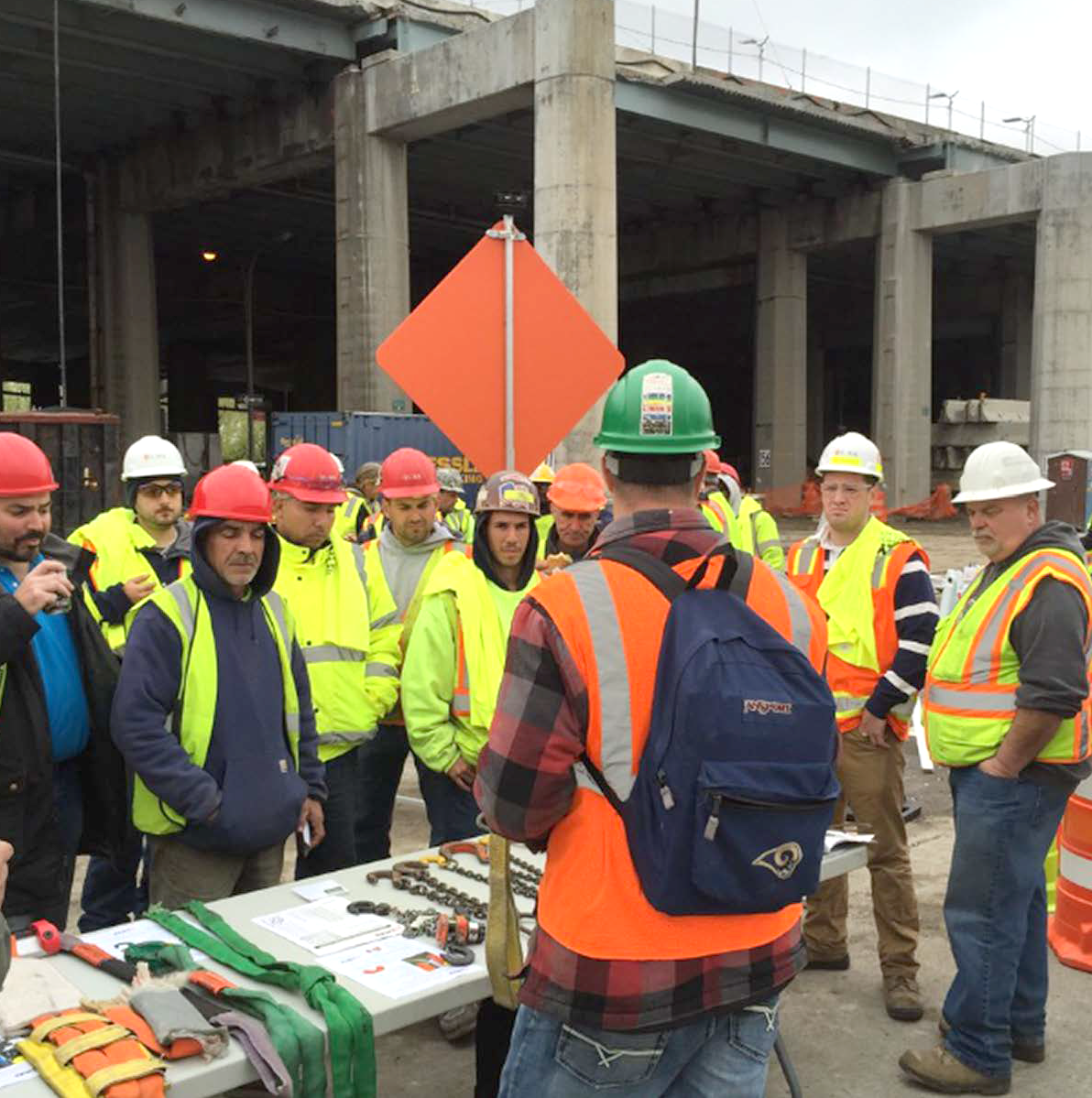
Users must be trained in safe lifting procedures, inspection, and maintenance. Lift-All offers Safety-in-Lifting training in both English and Spanish covering these topics to help you meet ASME and OSHA guidelines. This presentation suggests the best sling types for common applications and ensures attendees learn proper maintenance in accordance with the standards.
Do I have to document every sling inspection to meet ASME B30.9?
There are two scenarios.
For a new or repaired product, Lift-All provides a “Certificate of Conformance” or “Certificate of Proof Test & Conformance” stating the product meets industry standards.
For products in service, documentation isn’t required for every frequent (pre-use) inspection, but having records for periodic inspections is essential.
An OSHA inspector generally only asks to see the initial Proof Test Certification and the most recent periodic inspection record.
Sling Certification vs. Proof Testing & Conformance
A Certificate of Conformance is our statement that the product meets the requirements as outlined. A Proof Test Certificate is almost the same, but it provides the specific proof load and states that the product was physically tensioned to that load.
Are all slings required to be proof tested?
No, not all slings require testing by law. However, Lift-All proof tests all new welded type chain slings and wire mesh slings as a standard. We also proof test mechanical chain slings even though this is not a strictly required OSHA or ASME standard.
Crucially, any repaired sling must be proof tested prior to being returned to use.
How Different Sling Types Achieve OSHA & ASME Compliance
For web and synthetic slings, compliance relies on the tag and rejection criteria like cuts, burns, or abrasion.
Lift-All’s Web Sling Safety Bulletin also states limits for outdoor exposure—a unique requirement for that material. For chain, wire rope, and mesh slings, compliance is built on toughness and proof testing.
Do all sling types have the same design factor requirements?
No, design factors vary by material and standard. It is vital to consult the Lift-All catalog for specific design factors for each sling category to ensure the safety margin is appropriate for your specific lift.
In essence, for lifting:
- 5:1 ratio for most things
- 4:1 ratio for chains
- 3:1 ratio for non-lifting applications
How do you know if a sling still meets OSHA and ASME requirements?
Slings do not “expire.”
Standards require frequent inspections, and slings remain compliant as long as they pass the “Removal From Service Criteria” for that specific sling type, which can be found in the Lift-All catalog.
If a product passes through the removal criteria, it is technically still compliant with industry standards.
Required Sling Markings and Tags
Tags are mandatory for compliance. Each Lift-All sling has a serial number listed on the tag specific to that product, which can be used for traceability during audits and inspections.
Can I still use a sling if the tag is missing but the sling looks good?
No.
Both ASME B30.9 and OSHA 1910.184 state that slings need to be marked with identification, and the information must be legible.
If the tag is missing or unreadable, the sling must be removed from service immediately, regardless of its physical appearance.
Training and Third-Party Support
Lift-All is on a mission to advance safe lifting through our activity in the Web Sling and Tiedown Association (WSTDA).
We provide on-site sling safety and inspection services to educate users.
Furthermore, Lift-All is a member of the Industrial Training International (ITI) Advanced Rigging Network, providing world-class training to our customers.
Is sling safety training required for OSHA and ASME compliance?
Yes, in the sense that OSHA requires a “qualified person” to handle rigging.
If you are unsure of the standards and regulations required of you, you must ask your employer for training.
DO NOT use slings if you are unsure of what you are doing, as a lack of knowledge can result in injury or death.
Can a manufacturer help with my OSHA sling inspection requirements?
Yes.
Lift-All’s team trained experts can inspect your slings in one survey to keep you compliant.
We stay knowledgeable of all changes within the industry to ensure your equipment meets every requirement.